4-Week At-Home Workout Plan: Minimal Gear, Daily Stretch
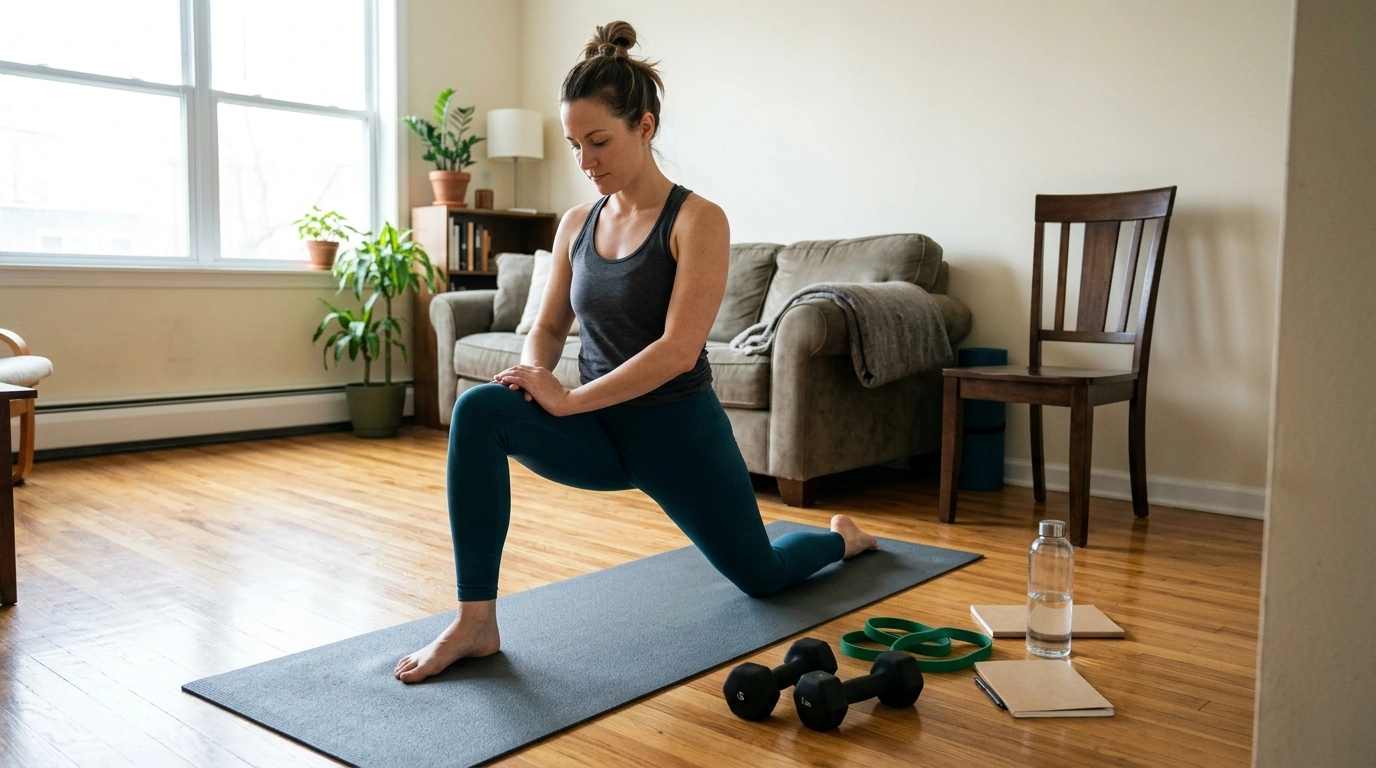
Fit at Home: A 4-Week Minimal-Equipment Workout Plan with Daily Workouts and Stretches
A structured four-week routine can remove guesswork, keep sessions consistent, and build strength, mobility, and conditioning without a full gym. This guide breaks down how a minimal-equipment plan typically works, how to pace effort across the week, and how to use daily stretches to support recovery and better movement. For more guidance, see Fitness program: 5 steps to get started.
Who this 4-week plan fits best
- Busy schedules that need a repeatable routine with clear daily direction and a defined endpoint (4 weeks).
- Home exercisers who prefer minimal equipment (bodyweight plus a small set of basics) and limited space.
- Beginners who want a simple structure and options to scale difficulty up or down.
- People returning to training who need progressive volume and built-in recovery days.
- Anyone who benefits from daily stretching prompts to reduce stiffness and improve movement quality.
Minimal equipment and setup
- Space needs: a clear floor area roughly the size of a yoga mat plus room to hinge, lunge, and extend arms overhead.
- Helpful basics: exercise mat, a loop band or long resistance band, a pair of light-to-moderate dumbbells (optional), and a sturdy chair/bench for step-ups or incline push-ups.
- Household substitutions: backpack loaded with books (for squats/hinges), towels for sliders on smooth floors, stairs for step-ups, countertop for incline work.
- Comfort and safety checks: stable footwear (or barefoot on a non-slip mat), clear any tripping hazards, and keep water nearby.
- Tracking: simple log of sets/reps/time and perceived effort to guide weekly progression.
How a week is typically structured (strength, conditioning, and mobility)
- Balanced focus across the week: lower-body patterns (squat/hinge), upper-body push/pull, core stability, and light conditioning.
- Progressive overload without heavy equipment: add reps, add sets, reduce rest, increase time-under-tension, or move to a harder variation.
- Recovery is part of the plan: lighter days emphasize mobility, easy cardio, and technique to prevent burnout.
- Effort guidance: use a 1–10 effort scale; most strength sets sit around 6–8, leaving 1–3 reps “in reserve,” while conditioning can touch 8–9 briefly.
- Stretches after sessions: used to downshift and restore range of motion, especially around hips, upper back, and shoulders.
Example weekly rhythm for a minimal-equipment 4-week plan
| Day | Focus | Typical session pieces | Intensity |
|---|---|---|---|
| Day 1 | Full-body strength | Squat + push + core + short finisher | Moderate |
| Day 2 | Mobility + light cardio | Easy walk/bike + stretch sequence | Easy |
| Day 3 | Lower-body + posterior chain | Hinge + lunge + glute work + core | Moderate |
| Day 4 | Upper-body + conditioning | Push/pull + intervals or circuits | Moderate-hard |
| Day 5 | Active recovery | Mobility flow + breathing + gentle movement | Easy |
| Day 6 | Total-body circuit | Timed rounds + optional finisher | Moderate-hard |
| Day 7 | Rest or restoration | Light stretching and walking | Easy |
Daily session template: warm-up, workout, and stretches
- Warm-up (5–8 minutes): start with gentle heart-rate elevation (march in place, step jacks), then prep ankles, hips, thoracic spine, and shoulders.
- Movement prep ideas: bodyweight squats, hip hinges, shoulder circles, dead bugs, glute bridges, and light band pull-aparts.
- Main work (15–30 minutes): pick 4–6 moves that cover squat/hinge/push/pull/core; rotate patterns to manage fatigue (for example, lower-body move, then upper-body move, then core).
- Conditioning add-on (5–10 minutes): short intervals like 20 seconds work/40 seconds rest, or choose a brisk walk if jumping isn’t comfortable.
- Cool-down stretches (5–10 minutes): focus on hips (flexors, glutes), hamstrings, calves, chest, and upper back; breathe slowly to help your nervous system settle.
- Consistency rule: if time is tight, keep the warm-up and do fewer sets—skipping the day entirely is usually the bigger setback.
Progression across 4 weeks (without needing heavier weights)
- Week 1: learn the movement patterns, choose manageable variations, and stop shy of failure; prioritize clean reps.
- Week 2: add one small progression—1–2 reps per set, or one extra set on one exercise, or 5–10 seconds more per interval.
- Week 3: increase density by trimming rest slightly, or upgrade a variation (incline push-up → floor push-up; supported split squat → deeper range).
- Week 4: consolidate with consistent performance; repeat a benchmark workout and aim for better control, smoother pacing, or slightly higher reps—not a risky max-out.
- If you need modifications: shorten range of motion, use support (chair/rail), slow the tempo, or split the session into two mini-blocks.
Safety, recovery, and habit-building
- Pain vs. effort: stop for sharp pain, joint pain, numbness/tingling, or dizziness; muscle fatigue and a mild burn are normal.
- Recovery basics: prioritize sleep, hydration, and adequate protein/calories aligned with your goal (fat loss, maintenance, or muscle gain).
- Rest-day movement: easy walking and gentle stretching often reduce soreness without adding training stress.
- Desk stiffness support: daily hip flexor and chest stretching can improve workout positions and reduce that “stuck” feeling.
- Habit cues: train at a consistent time, keep equipment visible, and track completion rather than chasing perfect sessions.
For general activity targets and health context, see the CDC Physical Activity Guidelines for Adults and ACSM’s overview of resistance training for health and fitness. For further reading, see How to Build an Exercise Plan.
Using a printable PDF plan effectively
Helpful downloads and add-ons
- Fit at Home: 4-Week Workout Plan (PDF with daily workouts and stretches) ($21.99)
- Break the Tension: Stress Relief Techniques ($8.99)
FAQ
Is there a free PDF download for a full body gym workout book?
Yes, free PDFs exist, but quality varies—look for clear weekly structure, warm-ups, exercise demos, built-in recovery, and a realistic progression plan. Paid guides often add clearer daily instructions, safer programming, and printable tracking that makes it easier to follow through for the full month.












Leave a comment